
Elementor #31782



The Sacred
Vestments
A complete guide to clergy attire — its history, meaning, and the timeless craft behind every garment.
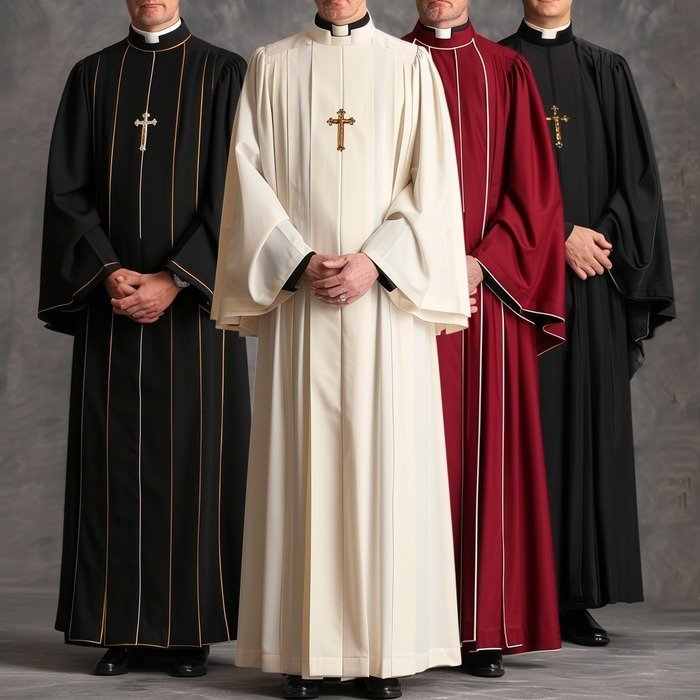
Clergy is far more than fabric and thread. For centuries, the vestments worn by priests, bishops, deacons, and ministers have served as living symbols — communicating faith, rank, tradition, and the sacred call to serve. From the flowing white alb to the richly embroidered chimere, every garment carries a story that stretches back through millennia of Christian worship.
Whether you are a newly ordained minister searching for your first alb, a bishop seeking a properly fitted chimere, or simply someone curious about the rich sartorial heritage of the Church, this guide will walk you through everything you need to know about clergy vestments — what they are, what they mean, and why quality matters.
Vestments are not merely clothing. They are a visible proclamation of an invisible calling — a reminder to the wearer and the congregation alike of the gravity and grace of holy service.
— On the Theology of Sacred DressFrom the Early Church
to Modern Ministry
The use of distinctive clothing for religious leaders is as old as religion itself. In the Hebrew scriptures, detailed instructions govern the dress of priests — linen garments, sashes, and the magnificent vestments of the High Priest. The early Christian Church inherited this understanding that sacred spaces and sacred roles deserve sacred dress.
The Roman Foundation
Early clergy wore ordinary Roman clothing — the tunica and toga — distinguishing themselves primarily through their conduct rather than their dress. As Christianity grew and gained legitimacy after Constantine, dedicated liturgical garments began to emerge.
The Age of Codification
The Roman Catholic Church began formally codifying liturgical dress. The alb, derived from the Roman dalmatica, became the fundamental undergarment of holy orders. The cope, chasuble, and stole emerged as distinctive marks of priestly office.
Reformation & the Anglican Tradition
The Protestant Reformation dramatically altered vestment traditions across Europe. In England, the Church of England established its own vestment requirements — retaining the surplice and alb but shedding many Catholic ceremonial layers. The chimere and rochet became distinctly Anglican episcopal dress.
Global Ministry, Modern Craft
Today, clergy vestments serve congregations across every continent. Modern craftsmen combine centuries of tradition with contemporary tailoring techniques — ensuring that ministers everywhere can dress with the dignity their calling deserves.
Four Essential
Clergy Vestments
Understanding the principal vestments of Christian ministry helps both clergy and congregations appreciate the depth of meaning behind what is worn in worship. Here are the four garments at the heart of the Anglican and broader Christian vestment tradition.
The Clergy Alb
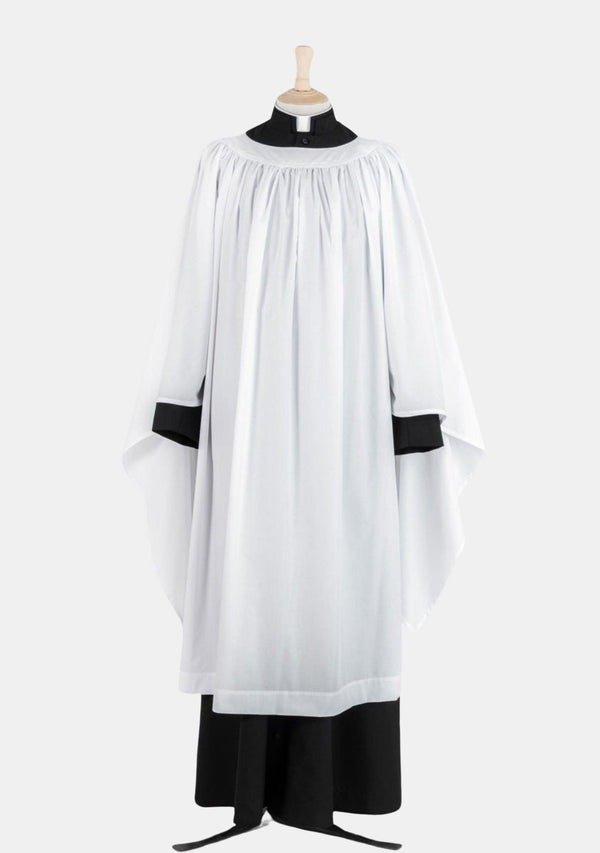
The alb — from the Latin alba, meaning white — is the long white robe worn by ordained ministers across virtually all Christian traditions. Its white color symbolizes purity, baptism, and the righteousness of Christ. The alb is typically worn beneath other vestments such as the stole or chasuble, and it forms the essential foundation of liturgical dress for priests, deacons, and servers alike.
The Clergy Apron
Historically associated with bishops in the Anglican tradition — particularly in their working or administrative dress — the apron (also known as the episcopal apron) is a distinctive garment worn as part of the traditional undress uniform of Anglican bishops. In broader ministry contexts, aprons also represent the servant nature of leadership, echoing Christ's act of washing the disciples' feet.
The Clergy Chimere
The chimere is a sleeveless gown traditionally worn by Anglican bishops over the rochet. Historically made of red or black satin, the chimere is a defining feature of Anglican episcopal dress. It traces its origins to a secular riding cloak used in medieval England and evolved into a formal symbol of the bishop's office. When worn with the rochet and tippet, it constitutes the traditional choir dress of an Anglican bishop.
The Clergy Jacket
The clergy jacket — often styled with a distinctive collar or designed to be worn with a clerical collar — bridges the sacred and the everyday. Suitable for pastoral visits, administrative work, school chaplaincy, and community ministry, a well-tailored clergy jacket allows ministers to carry the identity of their vocation in all settings, not just within the walls of the church.

The Case for Quality
in Sacred Dress
It is tempting, in an age of fast fashion and budget purchasing, to treat vestments as a simple utility purchase. But clergy attire is not a uniform — it is a theologically loaded garment worn in some of the most significant moments of human life: baptisms, marriages, funerals, ordinations, and the weekly gathering of the faithful.
Quality vestments endure. A well-made alb or chimere, properly cared for, can serve a minister for decades. Beyond durability, quality construction ensures proper drape and fit — garments that move with the wearer rather than against them, allowing the minister to focus on their calling rather than their clothing.
What to Look for in Clergy Vestments
- Quality fabric that holds its color and shape through repeated washing and wear
- Precise tailoring that provides dignified fit across varied body types
- Accurate traditional design that respects the historical and liturgical heritage
- Reinforced seams and stitching at points of stress — especially cuffs and hems
- Appropriate weight for the intended liturgical season and climate
- Easy-care properties that allow garments to maintain their appearance
- Correct length and proportion that matches ordained tradition
- Authentic color options conforming to liturgical color codes
Caring for Your Vestments
Sacred garments deserve careful attention. Always follow the care label, but as a general rule: vestments should be stored flat or on padded hangers, never folded along creases for extended periods. White garments such as albs and surplices should be washed promptly after use to prevent yellowing, particularly around the collar and cuffs.
Embroidered vestments should be dry-cleaned whenever possible to protect the needlework. When storing chimeres and other ceremonial garments between services, breathable garment bags — not plastic — preserve the fabric while allowing it to breathe.
Liturgical Colors and Their Meaning
The color of a vestment is never arbitrary. Liturgical color codes have been observed across Christian traditions for centuries, each carrying specific theological significance. White and gold speak of purity and celebration — appropriate for Christmas, Easter, and major feast days. Purple indicates penitence and is worn through Advent and Lent. Red recalls the fire of the Holy Spirit and the blood of martyrs, worn on Pentecost and saints' days. Green, the color of ordinary time, speaks of growth and the ongoing life of the Church.
Vestments for
Women in Ministry
The ordination of women across many Christian traditions over the past century has brought a welcome evolution in vestment design. Today, women clergy deserve the same quality of liturgical garments as their male counterparts — garments that honor the tradition while being designed and fitted for the female form.
The Ladies' Anglican Surplice, for example, combines the classic lines of the traditional English surplice with a cut and proportion tailored to the female figure. Similarly, albs and chimeres are now available in properly fitted cuts that maintain all the liturgical dignity of their traditional counterparts.
A minister who feels well-dressed and properly attired carries themselves with a confidence that communicates to their congregation. Vestments that fit and flatter — regardless of the wearer's gender — are an act of respect both for the minister and for the office they hold.
Dress with
Purpose & Dignity
Browse our complete collection of hand-crafted clergy vestments — albs, chimeres, aprons, and jackets — designed for ministers who take their calling seriously.
Explore the Collection